Hello, this is Fujishima from Jibunrashiku LLC.
Recently, I had a very meaningful experience. It was being interviewed by a university student about what it means to "live true to oneself." She will be using it for her university graduation thesis, and it's a theme that perfectly matches our company name, "Jibunrashiku LLC," which led me to delve deeply into it once again.
So, I'd like to share what I've carefully considered about what it means to "live true to oneself," from my own perspective. Oh, and I also feel that singing as a singer-songwriter is an important part of "living true to oneself."
The Gradation of "Inner Self" and "Outer Self"
When asked what it means to be "true to oneself," I first consider the multifaceted nature of human beings.
- Outer Self (Mask/Role): "Should do"
This is the consciousness of connection with society and how one is perceived by others. It is, so to speak, the self that tries to fulfill roles given in society and meet the expectations of those around them. - Inner Self (True Desires): "Want to do"
This comes from fundamental questions about one's own meaning in life and how one wants to live. True desires and passions reside here. It is also deeply connected to emotions like excitement, joy, anger, and sorrow.
These two do not have clear boundaries; in fact, they are seamlessly connected.
Two Perspectives that Shape "Self": Other-Oriented and Self-Oriented
Although "Johari's Window" in psychology presents four aspects, I believe that the "self" largely consists of two perspectives: "the self seen from within" and "the self seen from outside."
Among these, "the self seen from outside" is closely linked to society and responsibility. I call this the "other-oriented self." Here, "others" refers to "society," and in childhood, it would include "parents," "teachers," and "friends." Especially in early childhood, parental influence is significant, and the stronger parents' desire for their child to be "a certain way," the more difficult it can be for the child to see their inner self and true emotions.
And I feel that a culture strongly emphasizing this "other-oriented axis" is deeply rooted in Japanese society. For example, criteria for judgment such as "This painting is wonderful because it's by a famous artist highly regarded by society" or "This product is trustworthy because it's from a well-known company" often rely not on "how I feel about it," but on "what others say."
This might be related to the fact that many people feel "they lack confidence in making their own judgments" or "are unable to choose something for themselves."
Japanese Education That Obscures "Individuality"
I believe this cause is also related to Japanese education.
Japanese education is sometimes called "given education." Teachers stand at the podium, and students merely listen, read textbooks, and memorize what they are taught. There are few opportunities for deep independent thought.
For example, I hear that in Finland, emphasis is placed on asking "Why?" By being asked "Why?", children delve deeper themselves and acquire critical thinking skills. This, I believe, becomes the driving force behind their ability to make choices and decisions for themselves.
However, in Japan, the focus is on receiving information and memorizing it. "Answers" tend to be seen as something to "remember" rather than to "think about." As a result, I feel that the ability to consider how one feels, how one thinks, and what actions one can take accordingly is less developed. That might be why some people even lose sight of their "individuality."
In Japan, where many adults have few opportunities to be asked "What do you think?" or "What do you want to do?" throughout their lives, there's a tendency for "valuing oneself" to be perceived as "selfishness."
The Difference Between "Selfishness" and "Living True to Oneself," and the Connection to "Society"
So, what is the difference between "selfishness" and "living true to oneself"?
What becomes important there, I believe, is the connection to "society," that is, one's role and responsibilities in society. Isn't "individuality" strongly linked to these social aspects?
And there's another perspective I've been strongly conscious of since childhood: the perspective of "myself seen from the universe." Misdeeds that no one should see somehow get exposed. I've been convinced since I was little that this is due to a perspective that can only be described as a "great existence." That's why I've naturally lived with an awareness of "Intoku Yōhō (Secret Virtues, Open Rewards)."
Even when no one is watching, I've tried to "do what I believe is good." I also believe that this has led to my good fortune (where good things tend to happen in unfortunate circumstances). By reflecting on oneself and repenting mistakes, one's subsequent life becomes better. I feel it's always necessary to introspect to fulfill one's desires.
"What kind of 'me' do I want myself to be?" This question seems deeply connected to this "universe-from-above perspective." That's why I also consider how others perceive me.
I believe the view that "I know myself best" is actually a perspective that lacks an aerial view. We can never see "ourselves" from the outside throughout our lives. I can never see the back of my head or my back. This is because we can only truly know ourselves through "others" – our inverted reflection in a mirror, our image in a photograph, or by being told our impression by others.
Only by accepting this perspective can we truly connect with others, I believe. In psychology, this is called "self-perception." Many people assume they have this, but surprisingly, many live by only reflecting on convenient, shallow aspects, avoiding facing their "true messy self."
However, both U-chan, the university student who interviewed me, and I myself enjoy this journey of discovering our "uncool selves." People who know their "uncool selves" are surely kind. Perhaps it's precisely because they know their own awkwardness and immaturity that they can have warm, empathetic interest in others.
Three Pillars for "Living True to Oneself" and "Responsibility"
And in balancing the "other-oriented self" and the "self-oriented self," I feel that "roles" and "responsibilities" are extremely important. I myself feel as if I've lived strongly conscious of "roles" and "responsibilities" precisely in pursuit of "my true self."
Ironically, my first impetus to "live true to myself" was my parents' constant demand for an "other-oriented self" when I was a child. The more my mother demanded it, the more I strongly sought "how I wanted to be myself." My mother often told me "don't show emotions," but I believe that "emotions" are precisely the barometer of "one's true self." Therefore, what I consider "living true to oneself" also includes cherishing "emotions."
Every time I was told "You're different," "You're not normal" by those around me since childhood, I felt anxious, and I even tried to be normal. But it was difficult. That's why, since junior high school, I've kept a daily diary, writing down events, emotions, and thoughts, then objectively observing them, repenting, and updating myself. Within that process, my constant thought of "I want to cherish myself" has, I believe, led to "living true to myself."
My inability to stick with club activities or jobs for long, my optimistic and impulsive first marriage, and subsequent divorce because of it, and my decision not to seek employment at a major corporation despite being a single mother – all of these are deeply connected to my experiences, traumas, and characteristics. I feel like I've constantly thought about how to leverage my "difficult-to-live-with" self, which is considered unusual by societal norms.
And that is how my current self was formed.
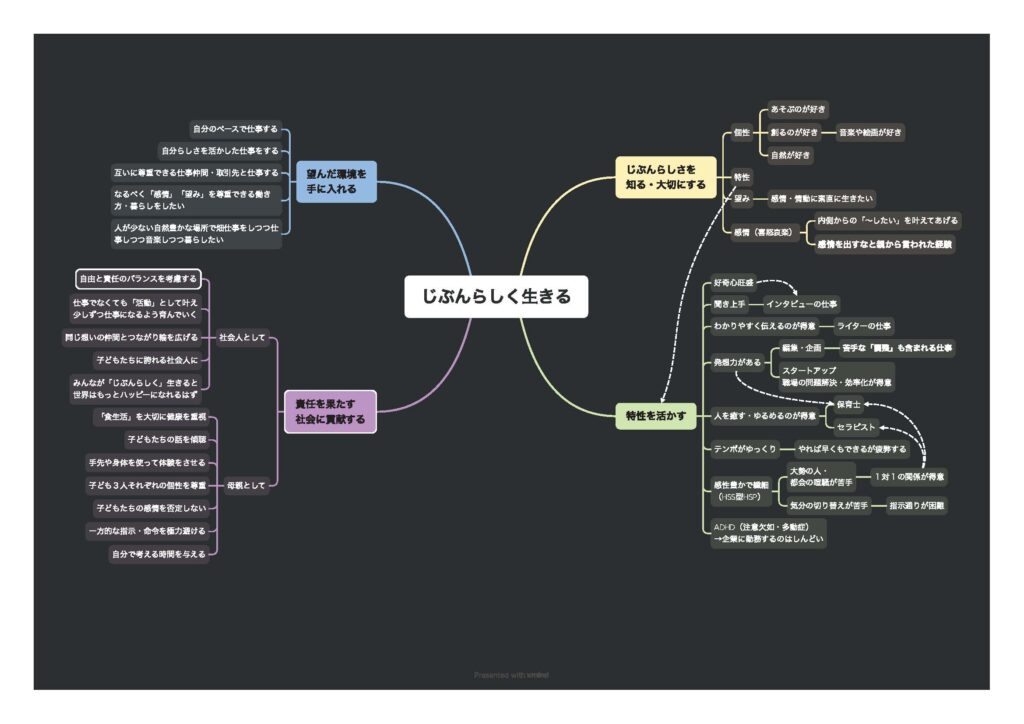
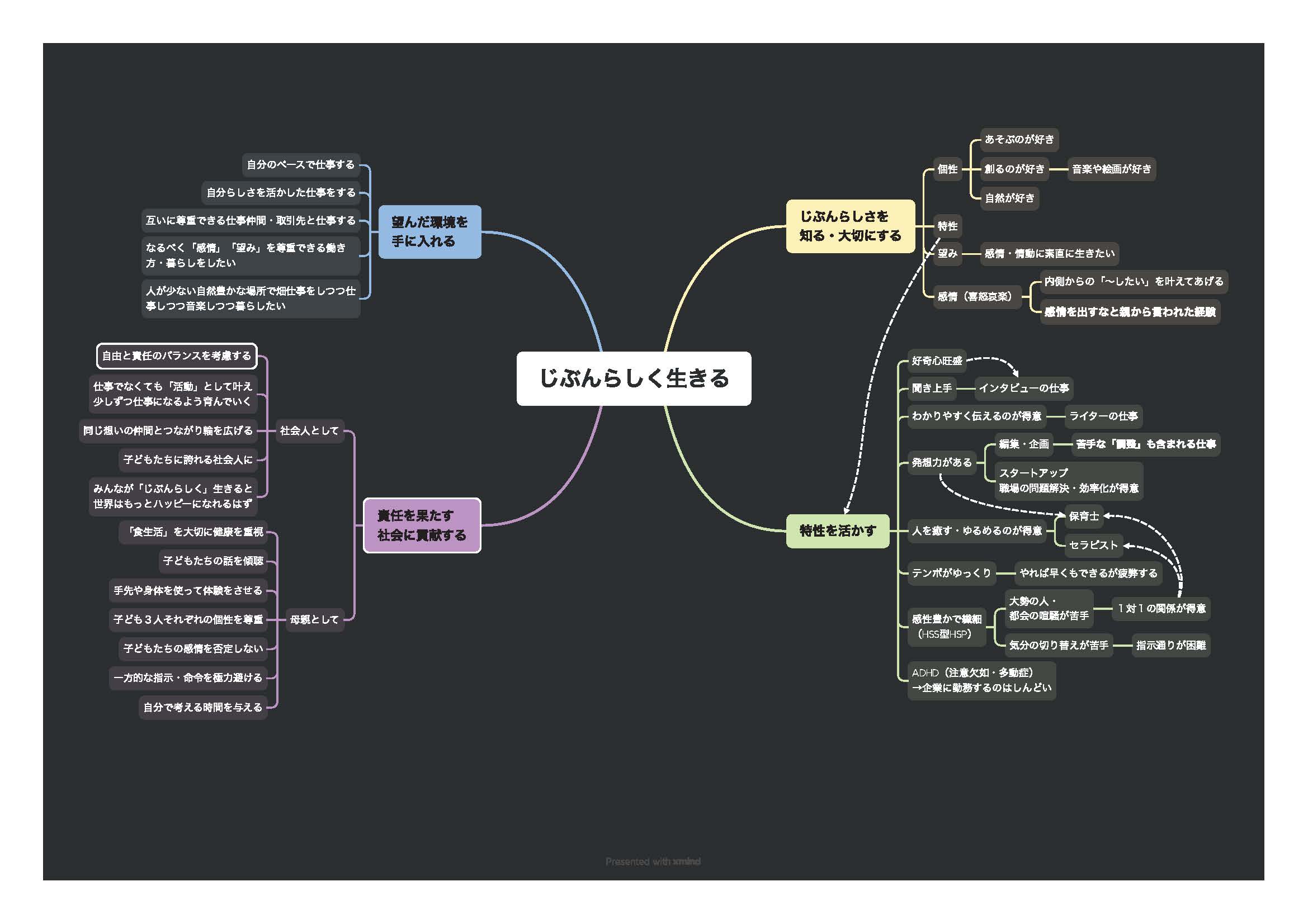
Now, what I consider "living true to oneself" is:
- Knowing and cherishing one's true self
- Utilizing one's unique traits
- Obtaining the desired environment
These things.
And on the other side of the seesaw of "living true to oneself," there might be the weight of "fulfilling responsibilities" and "contributing to society."
Through this interview, I strongly felt that perhaps I've worked hard at "motherhood" and "my job" precisely to "live true to myself." U-chan, thank you for giving me this wonderful opportunity.