Hello. I'm Hijiri Fujishima of Jibun Rashiku LLC.
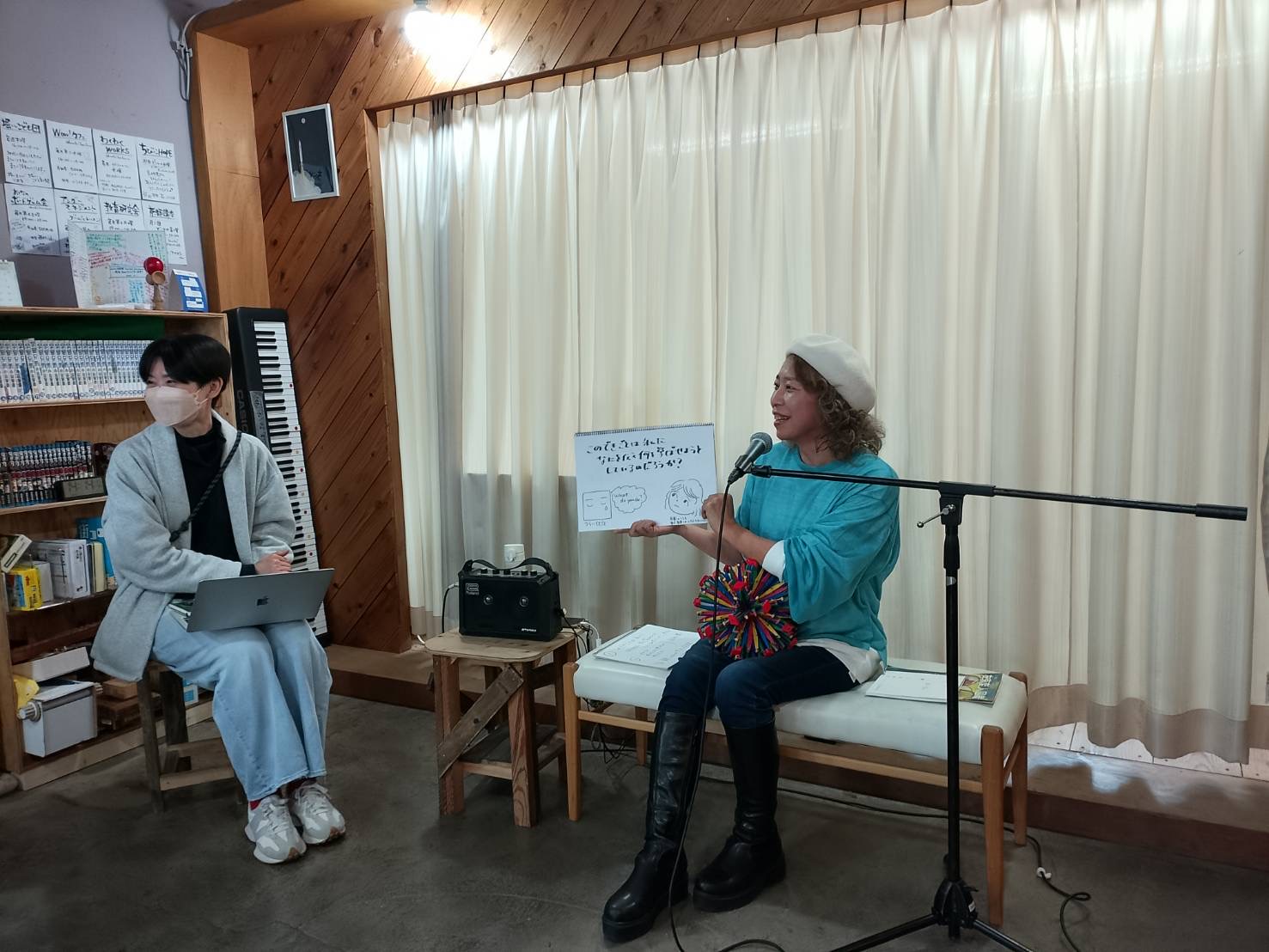
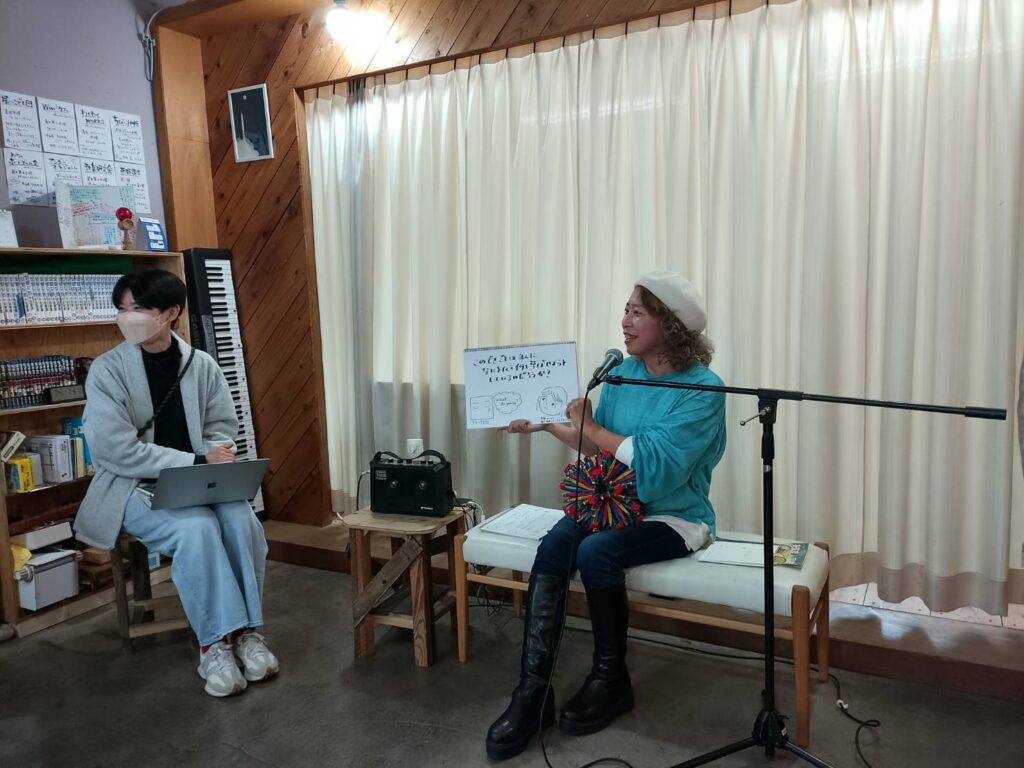
Every year, April 2nd is "World Autism Awareness Day." The period from the 2nd to the 8th of April is designated as "Developmental Disability Awareness Week" to deepen understanding of autism and developmental disabilities. Since my daughter and I have been diagnosed with developmental disabilities, I wanted to conduct awareness activities during this period this year. I consulted with two communities, "knocks! horikawa""House Yui", and an event was realized.
First, according to Government Public Relations Online, "developmental disabilities" are "disorders related to brain function development, such as pervasive developmental disorders, learning disabilities, and attention-deficit/hyperactivity disorder. People with developmental disabilities often find it very difficult to build relationships with others and communicate, but they may also exhibit excellent abilities. It is a disorder where their seemingly unbalanced characteristics are often misunderstood by those around them. For people with developmental disabilities to develop their individual abilities and become independent in society, 'awareness' and 'appropriate support' from childhood, as well as each of our understandings of developmental disabilities, are necessary."
In my case, I made many mistakes both at school and at work. Since these were remarkably similar to those of people around me who had been diagnosed with developmental disabilities, I visited a psychosomatic medicine clinic and was diagnosed with ADHD (Attention-Deficit/Hyperactivity Disorder).
Hyperactivity can manifest as physical actions, but also as relentless thought processes in the brain. In the case of women, some may have unstoppable chatter, but many may not appear hyperactive in their physical behavior. The past image of hyperactivity often involved boys walking around the classroom during lessons, and many school teachers believed, "if it's not like that, then it's not ADHD."
This was even more true for our generation. There was no understanding or support. I feel like I was simply scolded by adults for aspects like "forgetting things often," "not listening to the teacher," and "frequently getting injured or burned due to carelessness."
Developmental disabilities are understood differently by each psychiatrist and clinical psychologist. What I've come to realize after receiving consultations from many individuals is that the degree to which a person feels "disabled" is greatly influenced by their upbringing, including "parent-child relationships."
For example, our generation, now in their 50s and 60s, whose parents were born around World War II, can be said to have been raised by over-controlling and verbally abusive parents, often referred to as "toxic parents." This is due to the lingering effects of the patriarchal system and the war, which led to distorted parent-child relationships, with some theories suggesting that over half of these families were dysfunctional.
Consequently, when they become parents themselves, they tend to overly coddle their children. They respect "individuality" as they wished their own parents had, and rather than scolding for what cannot be done, they offer support.
Children in their 20s and 30s with "developmental disabilities" who were spoiled by "accommodating" parents have not experienced "strictness" in a positive sense. Many individuals with developmental disabilities are observed to have given up on challenging themselves. For instance, there are many patterns where parents, by being overly accommodating—such as setting their child's timetable for six years of elementary school to prevent forgotten items—end up depriving them of "opportunities to challenge themselves."
Furthermore, there are issues within the "society" surrounding individuals with developmental disabilities. As a result of pursuing efficiency and convenience during the period of high economic growth, opportunities to learn "communication" have decreased, such as being able to shop at supermarkets and convenience stores without speaking a single word. When we were little, we couldn't shop without speaking to the store clerk, saying things like "Please give me five eggs," or "One bunch of spinach and a mound of carrots, please." I believe this kind of society also contributes to the problem.
There are also issues with "education." It is believed that the Japanese education system, which has for many years emphasized standardized and 'giving' education (where teachers unilaterally provide information from the podium for students to memorize), is also a cause. For an easy-to-understand article on this point, please refer to a past interview article, "Sakyo Henjin Zukan (Sakyo Eccentrics Guide)". The interview article with former Kyoto Seika University President Oussouby Sacko is highly recommended. For Fujishima, who worked as a nursery school teacher, then an editor for a job information magazine, and later a writer for educational magazines at Nikkei BP and Shogakukan, these issues have long felt like detrimental effects of such an education system.
"Everyone should be the same."
"Everyone must be the same."
Those who are not become "disabled persons."
Developmental disabilities lead to difficulties in life because they are not the same when compared to the standard of "everyone developing in the same way," i.e., "neurotypical development." In other words, they are relative disabilities.
The "disability" itself is a disability *for this society*; if there were a different "society," it might not be a disability there. For example, if basic income* were introduced in Japan, it's conceivable that the number of "people with disabilities" might decrease.
I also discussed the limitations of the psychological "questionnaire method" regarding the interpretation of "diagnosis." Diagnosis through questionnaires is an old method used by psychiatrist and psychologist Jung, who proposed "type theory" using this method. However, Jung himself wrote in his book "Psychological Types":
"Every human being possesses two mechanisms, namely introversion and extraversion, and it is merely the relatively dominant one that constitutes that person's type." (Psychological Types / C.G. Jung)
In other words, I want you to understand that both introversion and extraversion exist within one person, and these assessments merely measure a "temporarily dominant tendency," not something that is "fixed" or "one-sided" for that person, as Jung himself conveyed. Some people are surprised to see an extroverted side in an introverted person, but both are inherent.
It's the same with developmental disabilities: people with ASD (autistic traits) also have aspects of ADHD, and people with ADHD can also show fixations and hyperfocus. It's not that they only have one side. While views on this theory still seem to differ among psychiatrists and clinical psychologists, I believe we should firmly adhere to Jung's perspective.
Therefore, what's important is to truly see "the person in front of you" and listen to them. I often receive consultations on how to deal with a family member diagnosed with ADHD, but there is no "correct answer" to "deal" with someone "because they have ADHD." ...I wanted to convey this in my talk.
Mikiko Konishi, one of the operators of "House Yui," one of the venues for this event, questioned why her daughter Yuko, who has Down syndrome, was immediately picked up and carried during walks when she was in daycare. The daycare teachers assumed, "children with Down syndrome have weak muscles, so they can't walk." As a mother, who had raised her daughter with exercise, she knew Yuko's leg strength and asked them to "let her walk." However, the teachers, knowing about Down syndrome "as knowledge," still carried her. Understanding the lament of a mother who had painstakingly built her child's body for exercise, as a former daycare teacher myself and having raised a child with developmental disabilities, this story made me ponder deeply.
If there were a "society" where the term "developmental disability" itself would one day disappear, then perhaps it would truly be accepted as "that's just 'individuality'."
Currently, both at school and at work, "being the same" is demanded. Not being able to keep up is deemed a "disability." However, if voices questioning that fundamental "society" gather, I feel that people would find it easier to joyfully embrace their own characteristics, discover ways to utilize them, and happily accept "traits" labeled as "developmental disabilities" to devise "strategies."
I spoke about this perspective on developmental disabilities, both as an individual with a diagnosis and as a family member. A former elementary school teacher and a clinical psychologist have expressed interest in collaborating, so please look forward to future developments.
*A system where all citizens periodically receive a fixed amount of cash from the government. Its characteristic is that anyone receives it unconditionally, regardless of age, income, or employment status.
【knocks! horikawa】 A community space located within a shopping street, a relaxed and casual gathering place.
It's a new space in Horikawa Shopping Street, Kamigyo Ward, Kyoto City, combining a learning place for children and a community-shared library. It's a place where everyone, regardless of age, can interact across generations with three keywords: learning, books, and art—all essential for living a better life. This place aims to be a "place to encounter one's own choices." (From the official website)
【House Yui】 A space where you can chat on the veranda surrounding an earthen floor. The charm also lies in its hidden location, a renovated old folk house at the back of an alley.
We aim to create a place where everyone, from babies to the elderly, regardless of disability, can happily learn and spend time together, mixing freely🏡✨ Everyone is different, and that's good 💕 We're looking for like-minded friends♪ (From official Instagram) Open on Mondays, Wednesdays, and the 25th of every month.